
The rising costs of Private Schools in Bhiwani: High Fees, Costly Books & Solutions (2026)
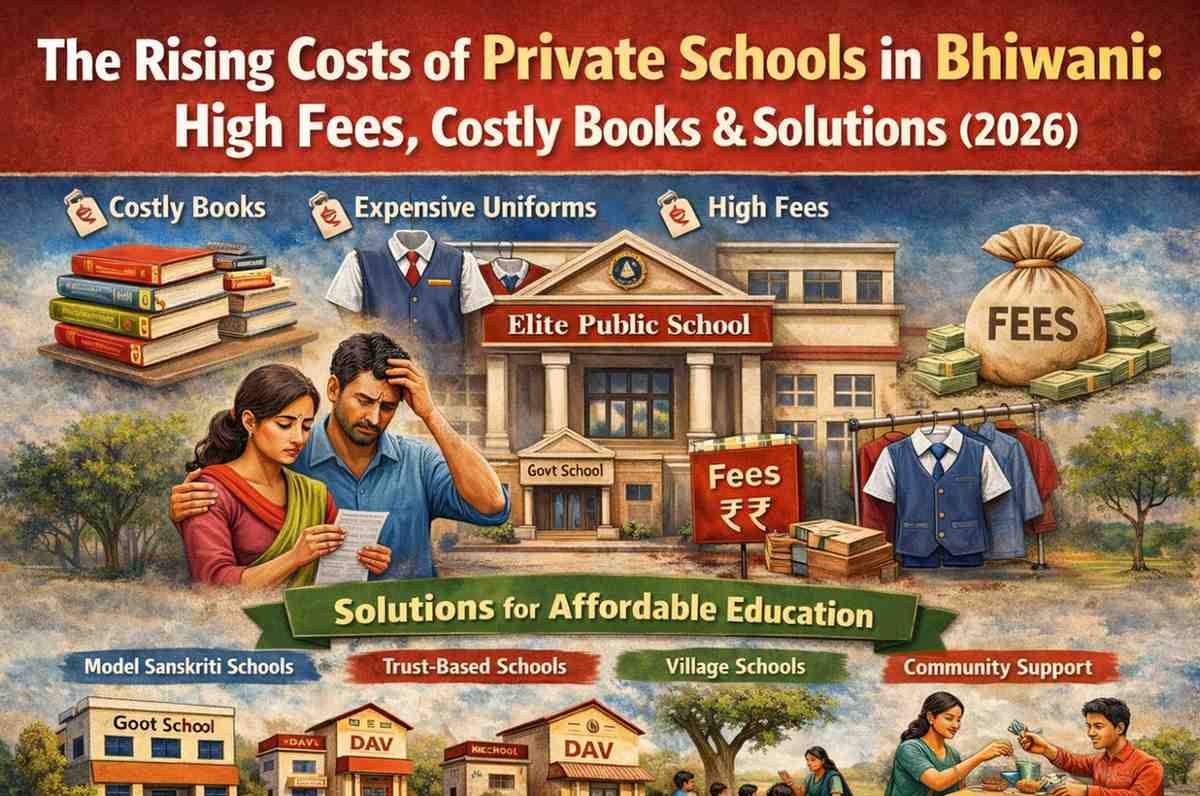
In recent years, education in Bhiwani and nearby areas of Haryana has undergone a major transformation. Private schools have expanded rapidly, offering modern infrastructure, English-medium education, and better exposure. While these developments have improved learning opportunities, many parents are increasingly concerned about the rising cost of education and the growing dominance of private institutions.
Issues such as expensive books, uniforms available only from fixed shops, and steadily increasing fees have created financial pressure on families. This situation raises an important question: Is quality education becoming too expensive for the common people in Bhiwani?
📈 Rise of Private School Dominance in Bhiwani
Bhiwani has long been known as an education hub of Haryana. With increasing demand for English-medium education and better academic results, private schools have gained popularity among parents.
Many families prefer private institutions due to:
- Modern infrastructure and facilities
- English-medium teaching
- Focus on discipline and results
- Better exposure to extracurricular activities
At the same time, it is important to acknowledge that many private schools genuinely work hard to provide quality education and invest in student development. However, the lack of affordable alternatives has led to a situation where parents often feel they have limited choices.
💸 Key Problems Faced by Parents
📚 1. Unnecessarily Costly Books
One of the most common concerns among parents in Bhiwani is the high cost of school books. In many cases:
- Parents are required to buy books from specific vendors
- Book sets include materials that are rarely used
- New editions are introduced frequently, making old books unusable
This results in significantly higher annual expenses, especially for families with more than one child.
👕 2. Expensive Uniforms from Fixed Shops
Another issue is the requirement to purchase uniforms from designated shops. Parents often report that:
- Prices are higher compared to open market options
- No flexibility is given to buy from other sources
- Minor design changes force fresh purchases every year
This reduces competition and creates a system where costs remain high.
💰 3. High and Increasing School Fees
Private school fees in Bhiwani have steadily increased over time. Apart from tuition fees, parents often pay:
- Annual development charges
- Activity and event fees
- Transport fees
- Technology or smart class charges
While some of these costs are justified due to better facilities, the overall financial burden can become difficult for many middle-class families.
⚖️ Why This Issue Needs Attention
Education is a fundamental necessity for every child. When access to quality education becomes expensive, it can create inequality and limit opportunities for many students.
In a growing city like Bhiwani, it is important to ensure that education remains accessible, fair, and affordable for all sections of society.
🛠️ Practical Solutions for a Better Education System
🏫 1. Strengthening Government Schools
One of the most effective solutions is improving government schools. Haryana has already taken steps in this direction through initiatives like Model Sanskriti Schools, which aim to provide quality education with modern facilities at affordable costs.
Further improvements can include:
- Better infrastructure and classrooms
- Digital learning and smart classes
- Skilled and motivated teachers
- English-medium sections where required
If government schools continue to improve, they can become a strong and affordable alternative to private institutions.
🤝 2. Promoting Trust-Based and Non-Profit Schools
Trust-based schools offer a balanced approach between quality and affordability. Examples like DAV Schools and institutions such as K.M. School in Bhiwani show how education can be delivered with reasonable fees while maintaining standards.
These schools focus more on education and values rather than profit, which helps in:
- Keeping fee structures reasonable
- Maintaining transparency
- Providing better accessibility to families
❤️ 3. Social Campaigns for Education Support
In India, people actively contribute to social and religious causes like temples and gaushalas. A similar approach can be adopted for education.
A community-driven campaign can:
- Encourage donations for school development
- Sponsor education for underprivileged children
- Support libraries, labs, and infrastructure
When society contributes collectively, education becomes a shared responsibility rather than a financial burden on individual families.
🌾 4. High-Quality Schools in Villages
Many families from nearby villages depend on city schools, increasing travel and overall costs. Establishing high-quality schools in rural areas can help reduce this pressure.
This can be achieved through:
- Government funding and schemes
- Public-private partnerships
- Local community contributions
Developing village-level schools with high standards will make education more accessible and reduce dependency on urban private schools.
📢 5. Awareness and Transparency
Parents also play an important role in improving the system. They can:
- Ask for detailed fee structures
- Participate in parent-teacher discussions
- Raise concerns collectively when needed
Better communication between schools and parents can lead to more transparent and fair practices.
⚖️ A Balanced Perspective
It is important to maintain a balanced view. Many private schools in Bhiwani provide quality education, experienced teachers, and modern facilities that justify certain costs.
The aim is not to oppose private education, but to ensure that it remains fair, transparent, and accessible to all.
🏁 Conclusion
The growing dominance of private schools in Bhiwani has brought both opportunities and challenges. While education standards have improved, rising costs related to books, uniforms, and fees have become a concern for many families.
By strengthening government initiatives like Model Sanskriti Schools, promoting trust-based institutions like DAV and KM schools, encouraging community support, and developing quality rural schools, a balanced education system can be achieved.
Education should empower every child—not become a financial burden. With collective efforts from government, society, and individuals, Bhiwani can move towards a more inclusive and affordable education system.